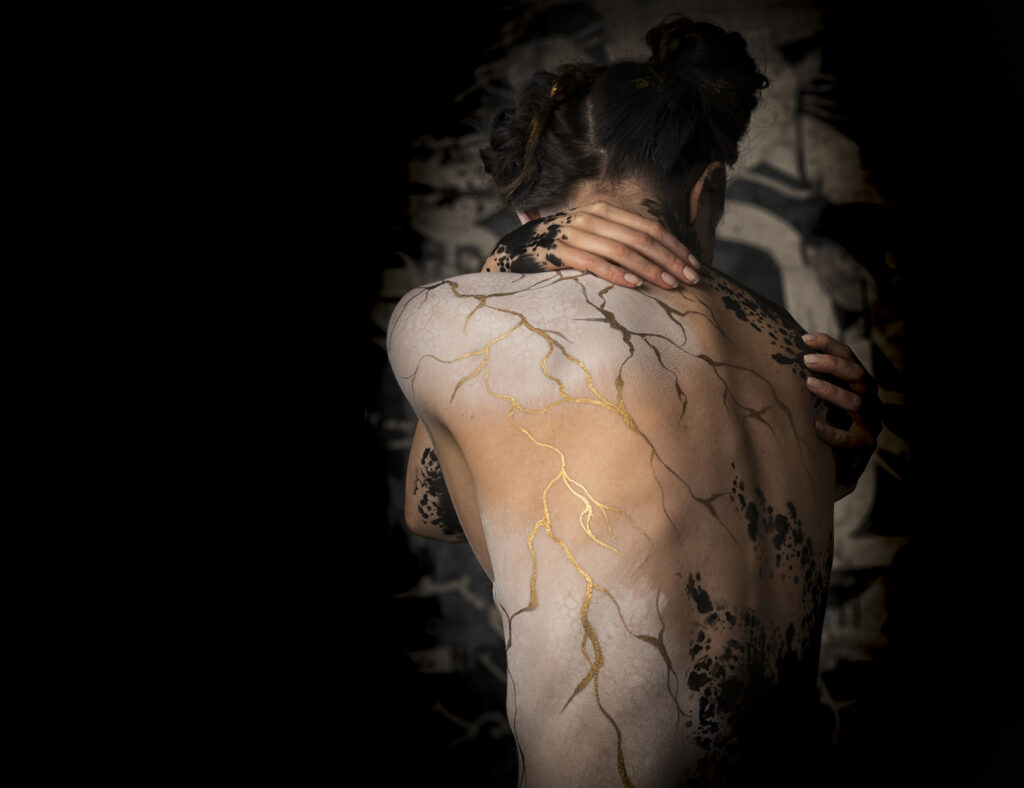
STUDIO711 (Adegem) & Jana De Guchtenaere (BE) MUA: Melicious Paints
Le concept du yin-yang provient de la philosophie chinoise ancienne et repose sur l’idée de dualité dans l’univers. Il symbolise l’interdépendance et l’équilibre entre deux forces opposées mais complémentaires.
Le yin et le yang ne sont pas en opposition stricte mais en complémentarité. L’un ne peut exister sans l’autre. Par exemple, sans l’obscurité (yin), la lumière (yang) n’aurait pas de sens.
Le cercle divisé en deux parties, l’une noire (yin) et l’autre blanche (yang), contient une petite portion de l’autre en son sein (un point blanc dans le noir, un point noir dans le blanc). Cela montre que chaque force contient une part de l’autre, soulignant l’idée d’interdépendance.
Chaque photo peut raconter une histoire d’équilibre ou de tension entre deux éléments opposés, comme l’interaction entre l’homme et la nature ou la coexistence de la vie dans le silence d’un portrait.
The concept of yin-yang comes from ancient Chinese philosophy and is based on the idea of duality in the universe. It symbolises the interdependence and balance between two opposing but complementary forces.
Yin and yang are not strictly opposed but complementary. One cannot exist without the other. For example, without darkness (yin), light (yang) would have no meaning.
The circle divided into two parts, one black (yin) and the other white (yang), contains a small portion of the other within it (a white dot in the black, a black dot in the white). This shows that each force contains a part of the other, underlining the idea of interdependence.
Each photograph can tell a story of balance or tension between two opposing elements, such as the interaction between man and nature or the coexistence of life in the silence of a portrait.
Behind the scene
@ Copyright - Luc Mairesse
Toute reproduction interdite sans accord de l'auteur